
| |||||||||
Free Printable Writing Worksheets for BeginnersPreschool writing and pattern worksheets to print for beginners that are learning and practicing the letters of the alphabet. Scroll down or click here to find the link to the free printable worksheet pages, but please read the following warning first: Don't Start Too Early"The idea that parents should hurry reading, spelling, writing, or math ahead of children's normal development is not supported by a single replicable research study in the world or by any clinical experience in history. All history, research and common sense points in the opposite direction! We repeat: Any who push the three R's early deny the readiness the Creator built in - reasonably mature vision, hearing, taste, touch, smell, reason, brain growth, coordination - as clearly documented in our books Better Late Than Early  and School Can Wait." and School Can Wait."
~ Raymond Moore, The Successful Homeschool Family Handbook
According to Dr. Moore,
Children who begin their formal education later, learn to read and write more quickly and soon reach the level of their peers who began earlier. They do not stay 'behind' for long! Just because children in school are forced to begin reading in Grade 1, is no reason for your children to have the same fate. It has been suggested that forcing formal language and reading on children may, in fact, be denying them their childhood! Charlotte Mason ~ The Original Homeschooling Series So before you print out the worksheets that follow, remember a few guidelines to prevent your children from 'burnout':
1. Keep it funIt is important that you do not quench your children's enthusiasm by forcing them to apply themselves to worksheets, books and your agenda, when they would rather amuse themselves with other pursuits. At this age, children should have a daily routine that allows plenty of time for physical activity, both work and free play and time for self-inspired learning. It is also important that you do not require your children to attempt tasks that are beyond their ability as they need positive experiences to build confidence. Therefore do not do any activities, which you know are too advanced for your children. "There is reason to believe that the thrill the youngster finds in experimenting with the natural things about him at home is soon stifled by the distractions and regimentation of the typical school program." ~ Raymond Moore, Better Late Than Early I propose that you do as many learning activities as possible 'incidentally' while you are busy with your day, rather than in a formal 'sit down-and-learn' manner. Encourage your children to notice the world of letters and numbers around them.
Here are some suggestions for achieving this in an informal manner:
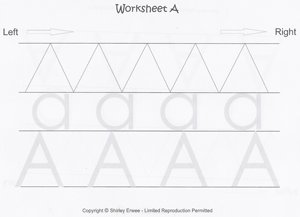
2. Keep it shortIf you have not already, then you will soon discover that young children generally have limited concentration spans and cannot sit still for extended periods. For this reason, education experts like the Moores, Charlotte Mason and others, recommend that formal lessons should be no longer than 20-30 minutes at a time. Allow your children to have a break and play outdoors for a while if you wish to resume a focused activity that you have planned. Research has shown that young children are naturally far-sighted as their eyes have not fully matured to function like that of an older person. For this reason, to avoid eye-strain, a child should not focus on a book or a page for more than 15-20 minutes at a time. When they write, encourage your children to make big letters at this stage. Later on (when they start Grade 1) they can learn to write neatly between lines! Only let your children do the worksheet activities provided if they are able to and are motivated to do them. At this early age, let us not take the fun element out of learning by forcing such formal activities on such young children. Do not to be too critical of a child's scrawled efforts, but encourage her to keep improving. If a child is loathe to write, then encourage her to do just three beautiful letters, rather than requiring a whole row of letters. This advice and the worksheets below are taken from A preschool programme, with gentle age-appropriate activities to teach children the alphabet, one letter per week. It includes easy kids crafts, reviews of recommended stories to read each week, alphabetized nursery rhymes, fun counting activities and more. All the preparation is done for you. For less than $1 per week, you just open the book and continue with your preschool lessons! Download Free Printable Alphabet WorksheetsClick on the link below to open the worksheet pages. There are 26 pages so they may take a while to load. Please note that these ABC Fun & 1-2-3 worksheets are copyrighted and that limited reproduction is permitted. Your integrity will be appreciated. Suggestion:
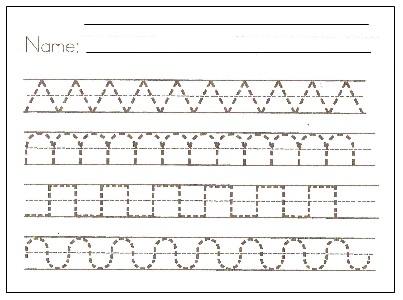
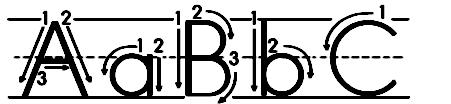
Let your children first practice writing the letter correctly in the air, then let them trace over the letters or patterns on the worksheets with their fingers before finally allowing them to write on the paper using a thick crayon or marker.
Preschool Writing Worksheets A-Z for Beginners
More Free Printable Preschool Worksheets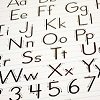 Free Printable Preschool Worksheets This page lists various printable alphabet pages, writing patterns, numbers, printable math activities, coloring pages, Bible memory verses and more! 
These is a list of free printable bible coloring pictures to accompany children's Bible stories and children's Bible lessons. 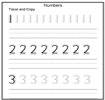
Free Printable Number Worksheets These pages contain the numbers 1-10 to trace and copy. There is also a blank lined page for extra practice in the set of printables. 
Coloring & Writing Left-handed This article explains how to teach left-handed children to color and write correctly from early on to avoid having to correct bad writing habits later.
|
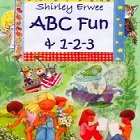
  ABC Fun & 1-2-3
by Shirley Erwee 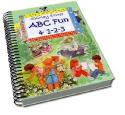 Less than $1 per weekShirley's gentle, age-appropriate preschool programme gives you alphabet-based activities each week, alphabet crafts, alphabetized nursery rhymes, number and counting activities, as well as a list of recommended, quality children's stories to read aloud together as you and your children adventure through the alphabet, one letter per week. All the hard work and planning is done for you - for less than $1 per week, you just open up the book and start the A-B-C fun! Click here for more details: z-wide-skyscraper-preschool.shtml***
|
||||||||
|
[?] Subscribe To This Site
|
|||||||||
|
Copyright © 2005-2020, Shirleys Preschool Activities.com All Rights Reserved. | |||||||||







New! Comments
Have your say! Leave a comment in the box below.