
| |||
School ReadinessSchool readiness refers to a stage in a child's development when she is ready to learn in a formal learning environment and can do so effectively and without emotional disturbance. School readiness is not a fixed point as growth and maturation is an ongoing process. It is a condition indicating that the child is ready to learn. A school-ready child will have developed physically (See School Maturity), socially, emotionally and intellectually to a level that will enable her to benefit fully in a primary school class. While School Maturity cannot be influenced, school readiness can be encouraged by exposing children to a wider range of experiences and encouraging them to develop their senses and skills. 
The Whole Child is a free newsletter that Shirley provides giving suggestions of school readiness activities that will stimulate the all round development of preschool children, including gross motor skills, fine motor skills, visual and auditory perception, numeracy and linguistic skills. Many of the areas of development listed down below cannot be developed by the child alone. A child needs an adult to guide her and give her opportunities to use her abilities and discover new concepts.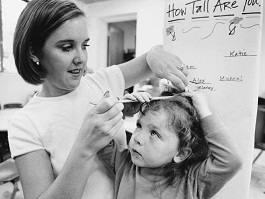
Children with good home backgrounds or good preschool experiences are more likely to be school ready than those who without.
Differences in DevelopmentAlthough all children do pass through the same physical stages of development, not all children develop at the same pace e.g. one child may walk at 11 months and another at 18 months, yet these are both accepted as normal. No two children have the same skills, talents, intelligence or develop in the same way. Here are parenting tips and a description of typical child development milestones for preschoolers as young as two and three years: Preschoolers Similarly, not all children reach school readiness at the same age or at the time of the start of their first year at primary school. Home education plays a very significant role in a child's development towards school readiness. Some children may not be school ready for some of the following reasons:
Ready for School? A ChecklistThe school may expect the following from a child starting Grade 1. 1. Physical health 2. Gross Motor Skills 3. Fine Motor Skills 4. Perceptual Abilities 5. Social Adaptation 6. Intellectual Ability 7. Concentration and Perseverance 8. Skills in Categorizing 9. Language Development 10. Emotional Readiness 11. Critical Thinking Skills 12. Hunger for Knowledge Subscribe today ...FREE
Subscribe today to THE WHOLE CHILD, a free e-zine packed with age-appropriate preschool activities to stimulate your children in a variety of ways, plus useful tips and info for YOU, delivered regularly to your inbox. In just a few minutes, doing one easy activity a day, you can have fun and interact your children in a way that will stimulate their all-round growth and development.
When you sign up, you will receive ideas and tips for:
Click on the links above for more information describing and explaining the importance of these activities, as well as some samples of the kinds of free preschool activities you can expect in THE WHOLE CHILD e-zine. You can read Back Issues here.
|
  ABC Fun & 1-2-3
by Shirley Erwee 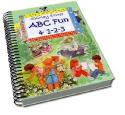 Less than $1 per weekShirley's gentle, age-appropriate preschool programme gives you alphabet-based activities each week, alphabet crafts, alphabetized nursery rhymes, number and counting activities, as well as a list of recommended, quality children's stories to read aloud together as you and your children adventure through the alphabet, one letter per week. All the hard work and planning is done for you - for less than $1 per week, you just open up the book and start the A-B-C fun! Click here for more details: 
A selection of carefully-chosen toys and games will help to create a 'learning environment' in your home, where your kids will develop skills they need through play! Use this as a wishlist for gifts for birthdays.  Thinking about homeschooling? Help others by giving answers! |
||
|
[?] Subscribe To This Site
|
|||
|
Copyright © 2005-2020, Shirleys Preschool Activities.com All Rights Reserved. | |||




New! Comments
Have your say! Leave a comment in the box below.