
| |||||||||
Early Math SkillsTips for developing early math skills in preschool children. Tips for Teaching Preschool Math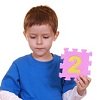 Read these articles: 1. What is Preschool Math? Counting by heart Activities - counting songs and rhymes 
Nursery rhymes that involve counting are a fun way to re-inforce numbers and early math skills - concepts, like counting, time, measurement, position, volume, temperature etc... One-to-one correspondence Activities - laying the table, sharing candy, counting any toys or household objects 
Reading numbers Activities - choose a number and see how many times you find it in a day Writing numbers Conservation of number Sorting Activities - play games where your child has to spot the odd one out eg. Categories of food, toys, vehicles, buildings etc. You could create a scrapbook with magazine cuttings to reinforce this concept by creating a page for each category. Measurement Sometimes this method is not possible. For example, you can't take a carpet from a shop to see if it will fit a room in your house, so then you need to measure it. This is why we have standard units of measurement like feet, inches, centimetres and metres. Young children can use anything as a unit of measure. For instance they could:
You can also measure curves using these units. Use a piece of string to measure the curved object and then measure the string with blocks, for instance. Estimating is a very important skill, for measuring and for Math in general. In every day life we estimate all the time. Talk about this with your child: "Is this enough milk for your cereal?" If a child can estimate answers to calculations he or she is less likely to make glaring errors. Top of Early Math Skills Stages of Addition1. Counting objects - 2 ladybugs plus 3 more ladybugs is 1,2,3,4,5 ladybugs. 2. Counting on - 2 ladybugs plus 3 more ladybugs is 2...3,4,5 ladybugs. 3. Counting on from the highest number - 2 ladybugs plus 3 more ladybugs is ...3,4,5 ladybugs. 4. Counting on fingers - If your child does this, she knows that the answer will be the same whether you count fingers or ladybugs! 5. Knowing number facts - She knows that 2+4 is always 6, so she doesn't need to count objects to check. These number facts are also known as number bonds.  Activities to help with counting on
Ladybug Math Activities make a number line board games counting objects Activities to help with number bonds SubtractionDifference - "I've got 2 buttons, she's got 5 so she's got 3 more than me!" Difference can be found by counting on. Activity - play 'grab the biggest pile' of raisins, buttons, pebbles, candy, then lay out two lines to see who won. Count to find the difference. Taking away - "I had 8 biscuits and I've eaten 2 so how many are left?" This is a more difficult concept. Activity - Make some ladybugs and hide some under a flowerpot: there were 6 and now there are 3 so how many are hiding? The most important things we can do to help our children with early math skills are: 
Top of Early Math Skills More Early Math Skills Telling the Time Skills for Telling the Time Clock Race Math Activity Snap-o-clock Math Game Racing Time Math Activity Shape Printable Shape Recognition Activities Build a House Shapes Math Activity Measurement Rain Gauge Activity Paper Plane Math Activity Number Recognition Draw a Face Math Game Dot-to-dot Math Activity Bonds and Addition Facts Spiders Math Activity Ladybug Math Activities Snap Math Game Tips for Teaching Preschool Math1. What is Preschool Math? 2. Early Math Skills 3. NEXT - Preschool Math Concepts and Activities |
  ABC Fun & 1-2-3
by Shirley Erwee 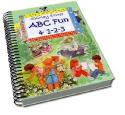 Less than $1 per weekShirley's gentle, age-appropriate preschool programme gives you alphabet-based activities each week, alphabet crafts, alphabetized nursery rhymes, number and counting activities, as well as a list of recommended, quality children's stories to read aloud together as you and your children adventure through the alphabet, one letter per week. All the hard work and planning is done for you - for less than $1 per week, you just open up the book and start the A-B-C fun! Click here for more details:
|
||||||||
|
[?] Subscribe To This Site
|
|||||||||
|
Copyright © 2005-2020, Shirleys Preschool Activities.com All Rights Reserved. | |||||||||







New! Comments
Have your say! Leave a comment in the box below.